|
|
 |
|
|
 |
| |
 |
| |
 |
Business Benefits: |
| |
 |
Maintained confidence
from customers, suppliers, partners and internal
stakeholders in the availability of critical business
applications in the event of disaster or infrastructure
failure |
|
Avoidance of revenue
loss and lost productivity from downtime of business-critical
applications |
|
|
IT Benefits: |
| |
|
Ability to identify
and rectify potential failure points in infrastructure
and management processes before failure occurs |
|
Prioritization of applications
and fault-tolerance measures to align technology
deployment with business goals |
|
Less operational pain
in troubleshooting and restoring critical
applications |
|
Improved utilization
of existing infrastructure through intelligent
use of load-balancing technologies |
|
|
Best Suited For: |
| |
|
Companies that have
recently consolidated their infrastructure
to support implementation of next-generation
integrated business applications (e.g, Siebel,
SAP, PeopleSoft, Oracle) |
|
Organizations without
a formal Disaster Recovery Plan in place |
|
Businesses with mission-critical
applications that must be available on a 24x7
basis |
|
|
Technologies Employed: |
| |
|
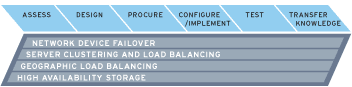
Network
equipment fail-over technologies such
as HSRP and VRRP which involve deployment
of routers and switches in a redundant fashion,
with two (or more) devices performing
the same role in the infrastructure and taking
over for each other in the event of failure. |
|
Server
clustering and load balancing providing
redundancy and intelligent load distribution
across multiple devices in case of unplanned
failure or scheduled downtime. |
|
Geographic
load balancing involving duplication
of infrastructure and data in different
geographical locations, for the purpose of
minimizing end-user response-time and providing
redundancy in the event of a large-scale catastrophic
event. |
|
High
availability storage technologies such
as RAID, Storage Area Networks (SANs), and
Network-Attached Storage (NAS) which provide
applications with uninterrupted data access
in the event of physical hardware or database
connectivity failure. |
|
|
Available Services: |
| |
|
Review and assessment
of application, server, storage, security,
connectivity, and physical facilities infrastructure
against best-practices |
|
Review and assessment
of disaster-recovery processes against best-practices |
|
Prioritization of availability and
fault-tolerance improvement measures based
on business objectives |
|
Design of network fail-over,
load-balancing and high-availability storage
infrastructures |
|
Competitive hardware
and/or software evaluation, selection and
procurement |
|
Implementation, testing
and documentation of infrastructure |
|
Training and knowledge
transfer to in-house staff, including lab
simulations |
|
|
|
|
|
| |
|